There’s a moment on the Stuart Highway somewhere south of Tennant Creek where the flat red scrub suddenly gives way to something that looks like a giant’s game of marbles got abandoned mid-play. Enormous rounded granite boulders, some perfectly balanced on top of each other, others split clean in half. It stops you in your tracks the first time you see it — even the kids, who by that point in a long lap had developed a fairly high threshold for “wow.”
That’s Devils Marbles. Or Karlu Karlu, to use its proper name — a sacred site for the Kaytetye, Warumungu, Alyawarr and Warlpiri peoples, and one that’s been drawing travellers and curiosity-seekers since explorers first pushed through this part of the Territory.
We stopped here on our way through the Northern Territory, and I’ll give you the honest version of what it’s like.
The Drive In and the Setting
Devils Marbles Conservation Reserve sits right on the Stuart Highway, about 105km south of Tennant Creek and roughly 393km north of Alice Springs. If you’re doing any kind of lap or Top End run, it’s directly on your route — there’s no detour required, which makes it an easy yes.
The site itself is split on both sides of the highway. Pull into the main carpark and you’re immediately walking among the boulders. The scale of them hits you differently in person than in photos. The largest are several metres high, and the way they’re stacked — some teetering in ways that defy what your brain tells you is physically possible — makes you stop and stare. The late afternoon sun turns the granite a deep burnt orange. In the right light, it genuinely is spectacular.
We arrived with enough time to explore before dusk, which I’d recommend. The light on the rocks in the last hour before sunset is worth engineering your travel day around.
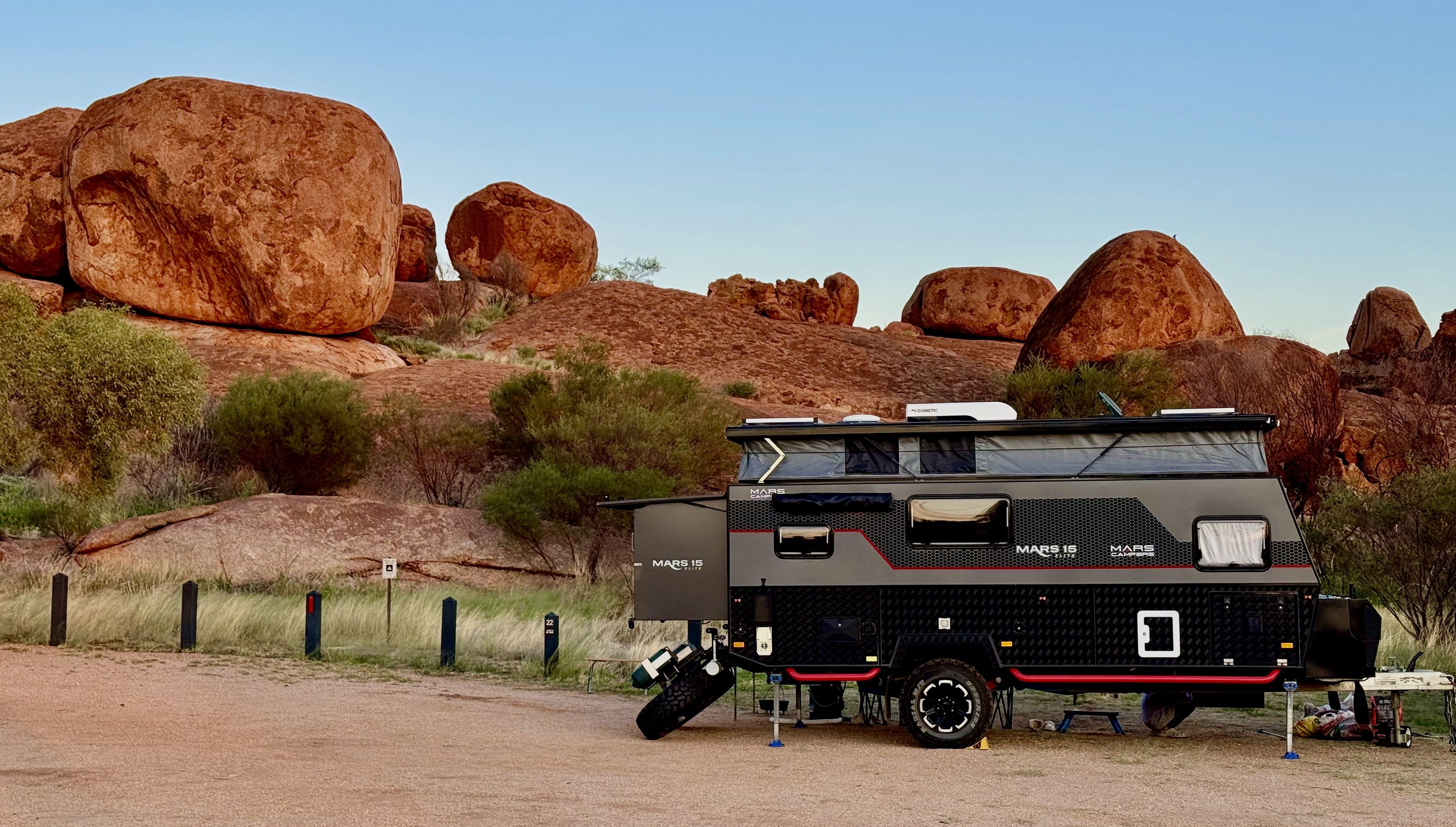
The Campground: Functional, Not Flash
There’s a basic campground on-site managed by Parks Australia. It’s flat, with fire rings, drop toilets, and not much else. No powered sites, no dump point, no shop. You need to be fully self-sufficient — water, food, gas, everything.
For a one or two-night stop as part of a longer journey, it does the job. It’s not a destination campground where you’d want to spend a week. The facilities are minimal and the setting, while dramatic during the golden hour, doesn’t offer a lot to do once you’ve walked through the boulders.
Fees apply — check the NT Parks website before you go as these change, and you’ll need to have your payment sorted in advance or carry cash.
The Flies. Oh, the Flies.
I’ll be straight with you: the flies at Devils Marbles were among the worst we encountered on the entire trip. And we’d been through some fly country by that point.
We set up to cook outside and within minutes it was a full-scale assault. Every exposed surface. Every bite of food. The kids weren’t impressed and neither were we. A good fly net for your hat is non-negotiable in this part of the world — if you don’t have one, add it to your kit before you head north.
And then, right at dusk, a swarm of flying ants decided our campsite was the perfect migration corridor. Thousands of them, moving through in a low dense cloud. We retreated inside the camper and watched it happen through the window. It lasted about twenty minutes. Dramatic, slightly unnerving, and completely out of our control. That’s the Territory for you.
What to Actually Do There
The main activity is walking among the boulders. There’s a loop walk of about 1.5km that takes you through the main formations — it’s flat, easy, suitable for all ages and fitness levels. Allow an hour to do it properly and stop for photos.
Sunrise and sunset are the times to be out. The colour change on the granite is genuinely something. Midday in summer is brutal and the rocks offer almost no shade, so plan accordingly.
There’s no interpretive centre or ranger on-site, but there’s good signage explaining the cultural significance of the site. Worth reading — it adds to the experience rather than just treating it as a photo backdrop.
The Honest Take
Devils Marbles is absolutely worth a stop. If you’re passing through on the Stuart Highway, you’d be mad not to. The boulders are genuinely extraordinary and the photography opportunities at golden hour are hard to beat.
But go in knowing it’s a waypoint, not a destination. One night is probably right for most people. The campground is basic, the flies are serious, and the local wildlife will remind you that you’re very much a visitor in this landscape.
We cooked inside that night after the flying ant migration. The kids thought the whole thing was hilarious in hindsight. That’s sort of the deal with remote Australia — the things that feel like an inconvenience at the time are usually the stories you’re still telling three months later.
Practical Info
Location: Stuart Highway, 105km south of Tennant Creek, NT
Facilities: Basic campground, drop toilets, fire rings. No power, no water, no shop.
Cost: Camping fees apply — check NT Parks for current rates
Best time to visit: May to August (dry season). Avoid December–February if you can.
Walk: 1.5km loop, flat, easy, 45–60 minutes
Nearest fuel: Tennant Creek (105km north) or Wauchope Roadhouse (nearby — check opening hours)
What to bring:
- Fly nets for your hats (we use these ones on Amazon AU) — genuinely essential
- Full water supply
- All food and cooking gear
- Good insect repellent
Have you stopped at Devils Marbles? Drop a comment below — we’d love to hear about your experience. And if you’re planning an NT trip, subscribe to the newsletter for more honest guides.